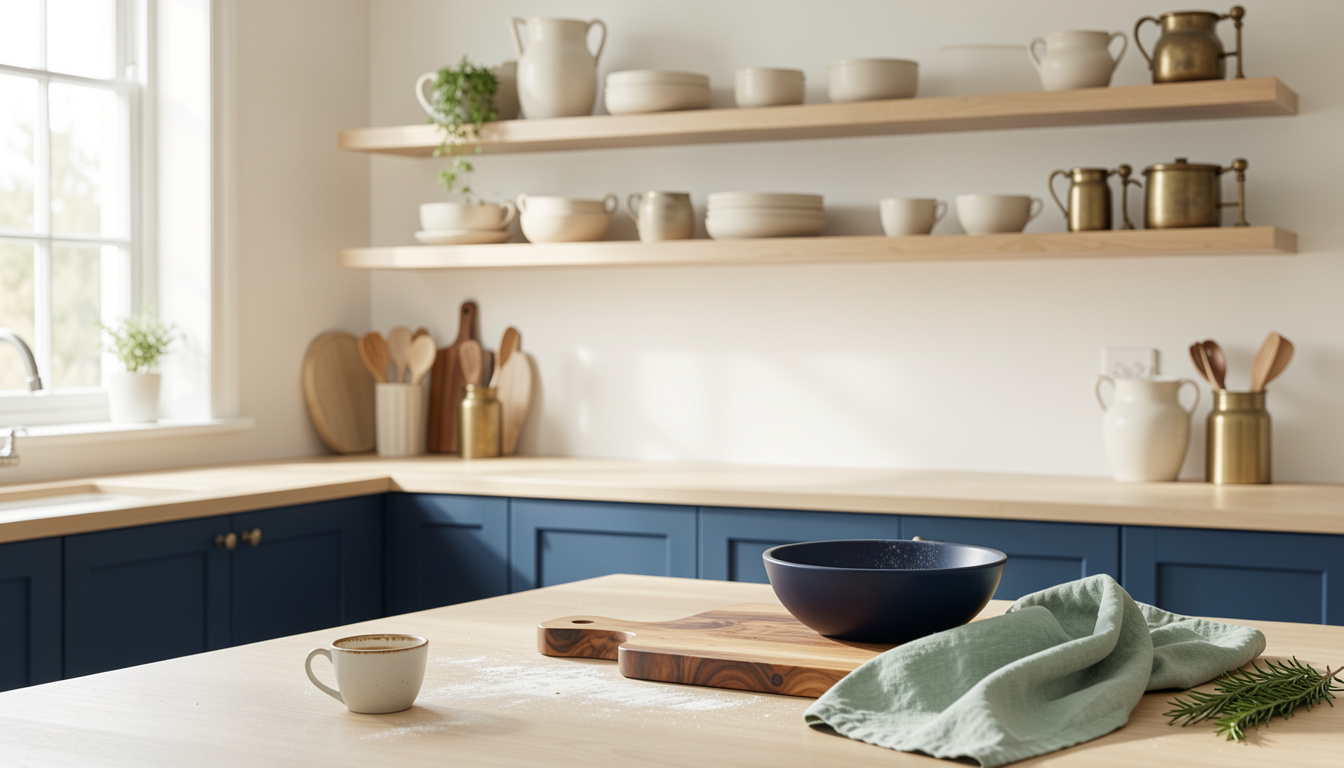
How to paint kitchen cabinets blue without ending up with brush marks or regret was the question that kept me up one weekend.
I painted my lower cabinets a deep navy for about $250 in paint and hardware swaps. People still stop by and ask where I bought them.
You’ll learn which blues read calm versus cramped, which finishes hide brush work, and where to spend versus save. Expect a refresh budget of roughly $200 to $500 for paint, rollers, and new pulls.
My kitchen leans modern coastal with warm oak counters and linen textures. This suits painted shaker cabinets and small islands.
If you want a full refinish budget, plan higher. I find most people can get a big visual change under $500 with the right paint and styling.
Remodeling’s 2023 Cost vs Value Report shows minor kitchen updates often recoup about 72 percent of their cost, so thoughtful paint plus styling is a smart visual investment.
1. Start with the Foundation: Counter and Cabinet Reset
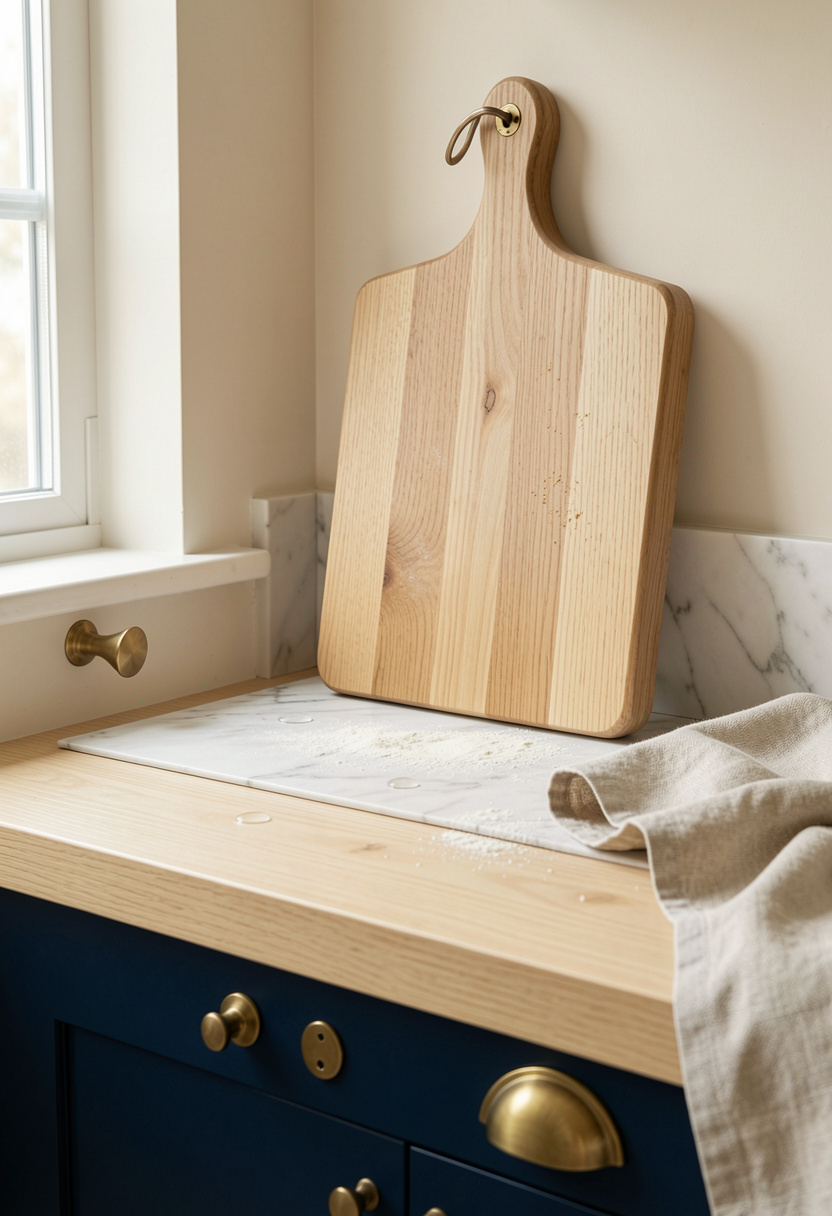
The foundation is the counter and visible cabinet faces because that’s where your eye lands.
Pick a paint finish that reads smooth and flat to photography. I used a Matte navy cabinet paint 1 quart for lower doors and a Soft blue cabinet paint 1 quart for uppers when I tried a two-tone look.
Balance with hardware that contrasts the blue. Brushed metal reads modern next to navy, so I swapped to Brushed brass cup pulls 3 inch.
The visual principle is contrast and rest. Dark base, lighter countertop, and warm metal give the eye a place to rest on the counter plane.
Mistake to avoid: painting deep blue and keeping chrome hardware. It creates visual friction. Change the finish first, then hardware for cohesion.
2. Layer Warmth with Wood and Linen Textures
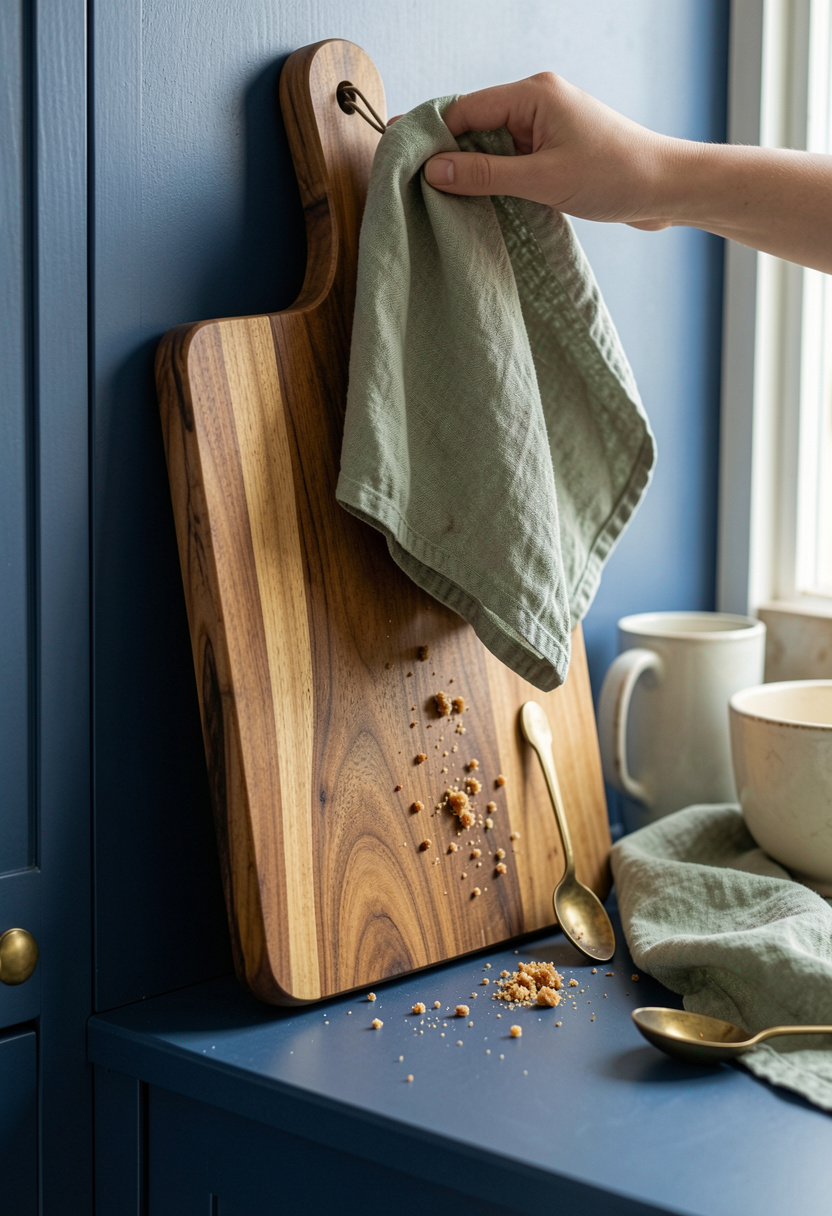
Blue needs a warm partner or it can feel clinical.
I layered a Large acacia cutting board 20 by 14 against the backsplash and stacked Sage linen tea towels set of 4 nearby.
The rule I use is one warm wood for every two cool surfaces. That ratio keeps the blue grounded.
Place the large board vertically for scale. Add a small ceramic bowl in the foreground at one-third of the counter length to break symmetry.
People often pile same-height objects. That reads flat. Instead, layer odd numbers and vary heights for a curated, lived-in look.
3. Add Height and Drama with Open Shelving and Two-Tone Balance
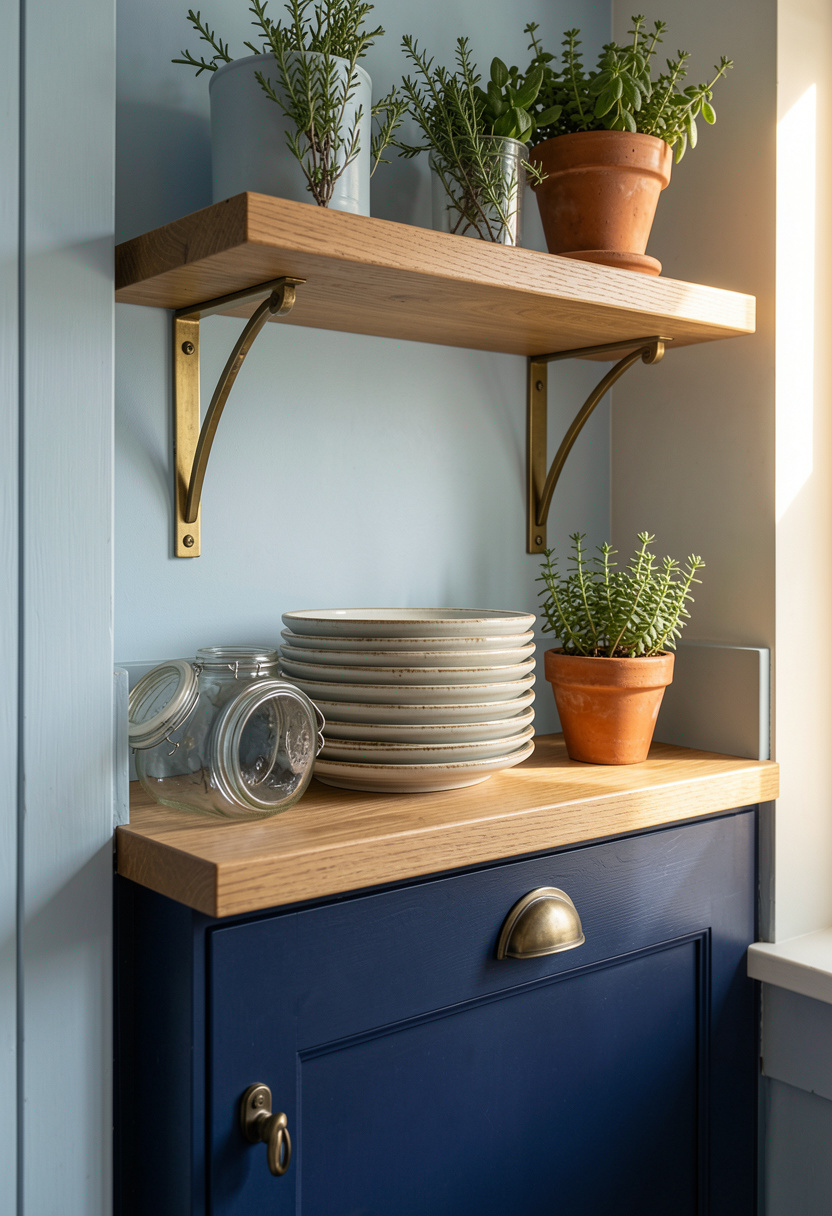
Open shelving gives your blue cabinets room to breathe and shows off complements.
I kept upper shelves light with the Oak floating shelf 24 inch and used Antique brass L brackets set of 4 as a repeat metal detail.
For two-tone balance, use a softer blue on the uppers so the navy base doesn’t dominate. The principle is vertical weight distribution. Darker at the bottom, lighter on top reads grounded and open.
Shelves should sit high enough that decorative pieces have negative space. Think 12 to 18 inches above the counter visually.
The ugly truth: full upper cabinets painted deep blue can make small kitchens feel boxed-in. Open shelving or a paler upper blue fixes that.
4. Create Ambiance with Warm Diffused Lighting
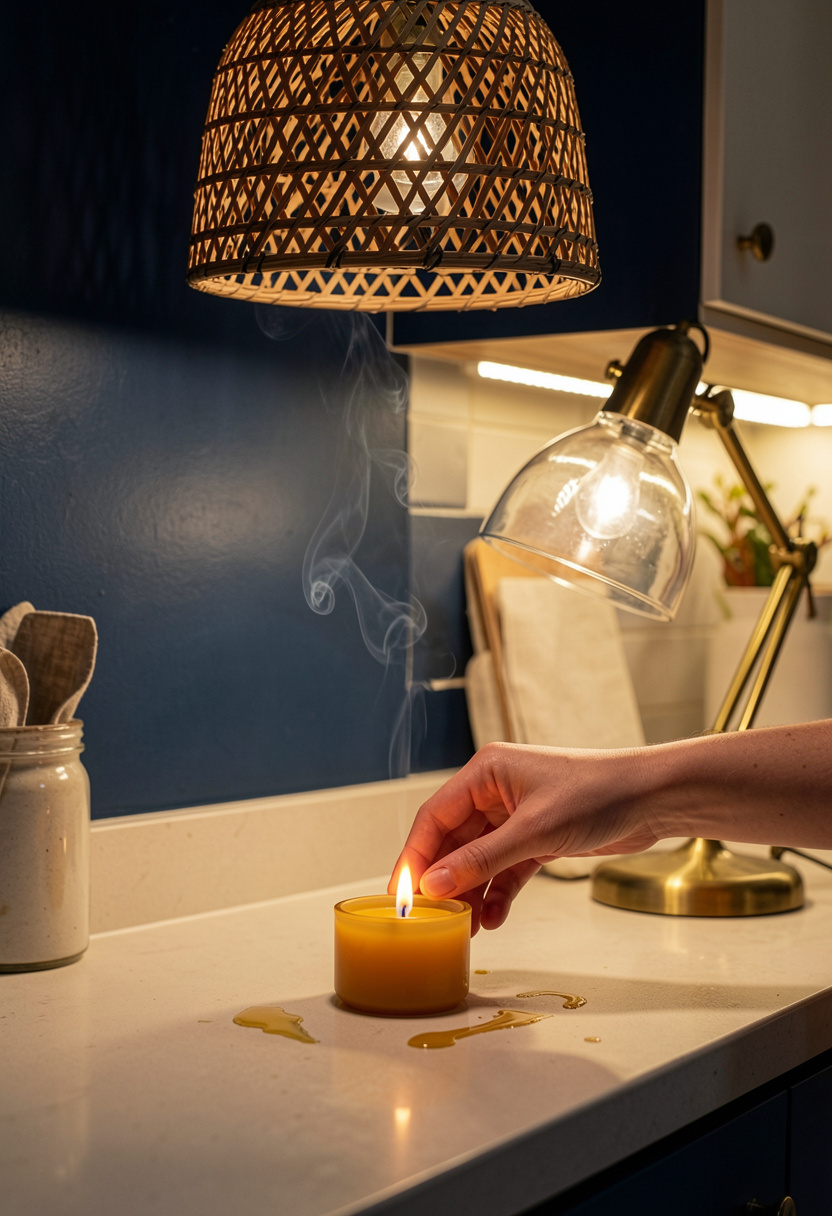
Lighting shifts how blue reads more than paint brand.
I layered a Rattan pendant light 15 inch with Warm under cabinet LED light strip 12 inch so the navy feels cozy in the evening.
Add a Glass and brass task lamp 12 inch for counter work zones and to repeat the brass tone.
The visual principle is layered light: ambient, task, accent. It prevents the blue from flattening out and creates depth.
Most people only change overhead lighting. That leaves the counter in shadow and the paint looking uneven. Invest in under-cabinet strips for instant polish.
Common Styling Mistakes to Avoid
Mistake: Choosing one saturated blue for every surface
Why it doesn't work: Overwhelms a small kitchen and hides architectural lines.
Do this instead: Pair Matte navy cabinet paint 1 quart on lowers with a softer blue above.
Mistake: Matching all hardware to the paint tone
Why it doesn't work: Looks manufactured and flat.
Do this instead: Mix finishes; try Brushed brass cup pulls 3 inch for warmth.
Mistake: Lining identical canisters in a row
Why it doesn't work: Creates visual monotony.
Do this instead: Use an odd-numbered trio like the Matte white ceramic canister set with acacia wood lids and stagger heights.
What You'll Need for This Look
Foundation Pieces
Large acacia cutting board 20 by 14 around $30 to $60
Marble look counter runner 24 by 60 around $20 to $40
Large matte navy fruit bowl 12 inch around $25 to $50
Textiles & Soft Goods
Sage linen tea towels set of 4 around $18 to $35
Natural jute kitchen rug 24 by 36 around $30 to $70
Linen oven mitt with loop around $10 to $20
Lighting
Warm under cabinet LED light strip 12 inch around $15 to $35
Rattan pendant light 15 inch around $60 to $150
Finishing Touches
Matte white ceramic canister set with acacia wood lids around $35 to $50
Small terracotta herb pot 4 inch around $6 to $15
Framed recipe art print 8 by 10 around $12 to $30
Budget Swaps
Farmhouse brass knob approx $5 to $12 each (thrift similar at local flea markets)
Acacia round chopping board 12 inch approx $15 to $30
Shopping Guide for This Look
Buy paint in small tester cans first: Try Matte navy cabinet paint 1 quart in different light for $15 to $25.
Thrift the heavy hits: Hunt for secondhand oak boards and brass at flea markets, then pair with Large acacia cutting board 20 by 14 as a new match.
2025 trend pick: Mix open shelving with biophilic touches like small herb pots; try Small terracotta herb pot 4 inch $6 to $15.
Splurge vs save: Splurge on lighting for ambiance with Rattan pendant light 15 inch $60 to $150 and save on towels with Sage linen tea towels set of 4 $18 to $35.
Seasonal timing: Buy larger brass hardware during holiday sales for up to 30 percent off and pair with Brushed brass cup pulls 3 inch $12 to $35.
Conclusion
Start with one cabinet face or just the island. Seeing a single blue panel in your space tells you if the color reads warm or cold.
Keep the paint matte on vertical faces, add warm wood, and repeat a metal finish twice for cohesion.
Which shade of blue are you leaning toward for your cabinets?