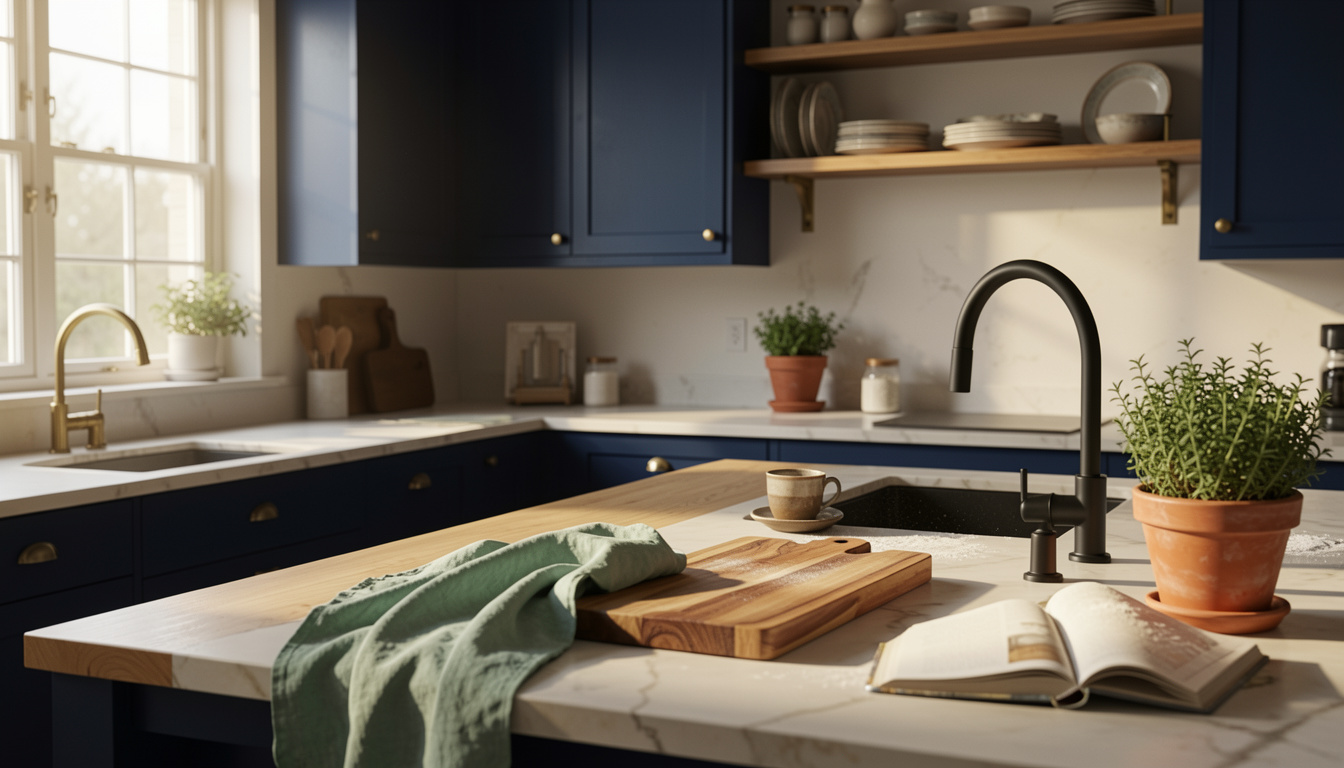
My navy cabinets used to feel like a paint sample gone too far.
how to match countertops with blue cabinets was a question I repeated while staring at swatches.
I spent $420 swapping accents, and the room stopped feeling cold. You’ll learn the exact countertop tones, textures, and finishing touches that work with blue cabinets, with options from budget refresh to a $1,500 small overhaul.
Painted-kitchen updates remain the most common cabinet change, according to Houzz’s 2023 U.S. Kitchen Trends Report. I’ll show practical choices that read designer-made, not catalog-perfect.
Modern coastal, farmhouse, and moody contemporary kitchens suit this plan. Plan on $200 to $1,500 depending on whether you’re styling or replacing counters.
I’ve noticed designers leaning into tonal palettes and sustainable materials for 2025. That’s where blue cabinets shine.
1. Start with the Foundation: Counter and Cabinet Reset
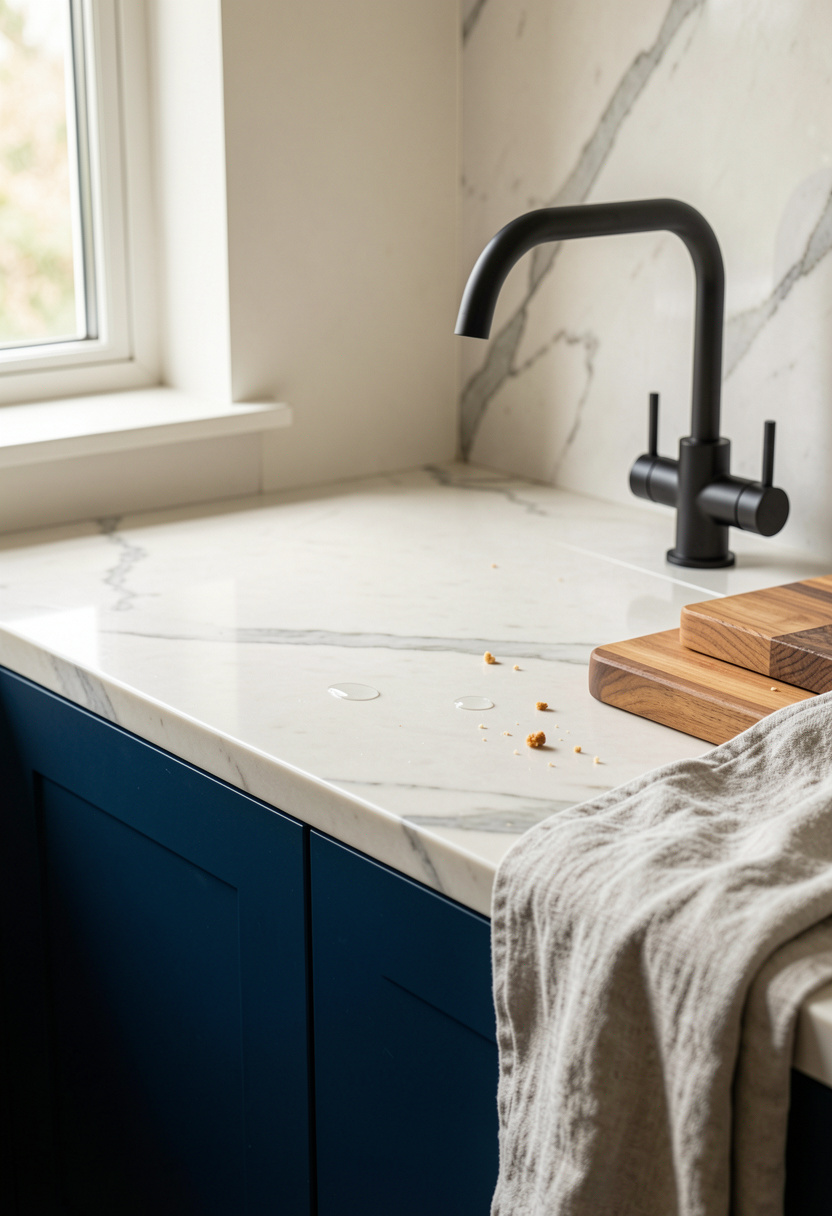
Begin by deciding cool or warm for the countertop. Blue cabinets can read crisp with cool-toned counters or cozy with warm stone.
If you want contrast, choose honed marble or light grey quartz. Try a Light grey quartz countertop sample or a Honed marble sample slab.
The visual principle is balance: a darker cabinet needs a counter that gives the eye rest. Keep the counter pattern subtle if cabinets are saturated navy.
Place large cutting boards vertically against backsplash for height. Use a 60/40 rule: counters should read about 60 percent quiet surface to 40 percent texture and accessories.
Mistake people make: choosing a busy veined stone that fights the cabinet color. Instead, sample swatches under your light and pick one with veins two shades lighter or darker.
2. Layer Warmth with Wood and Linen Textures
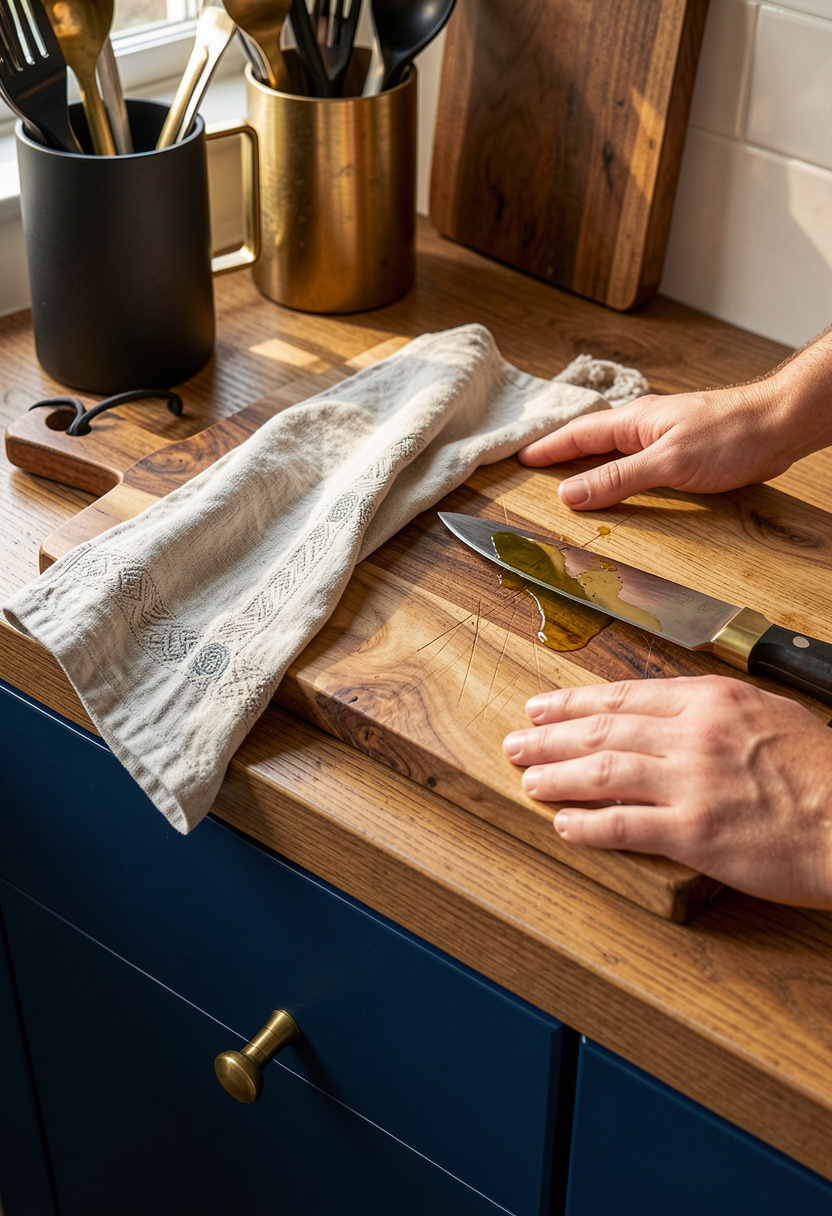
Wood tones save a cool-blue scheme from feeling clinical.
I layered a 24-inch acacia cutting board and a honey oak tray to warm the counter. Try an Extra large acacia cutting board 24 inch and an Honey oak serving tray.
The principle is texture contrast. Add linen towels in sage or natural to soften edges and repeat that color in small accessories.
Place wood pieces in thirds across the counter. One large board leaned near the range, a smaller bowl in the center, and a tray by the sink creates a rhythm.
Common mistake: piling wood on top of busy counters so everything competes. Instead, anchor wood near a single activity zone and let the stone breathe.
3. Add Height and Drama with Open Shelving
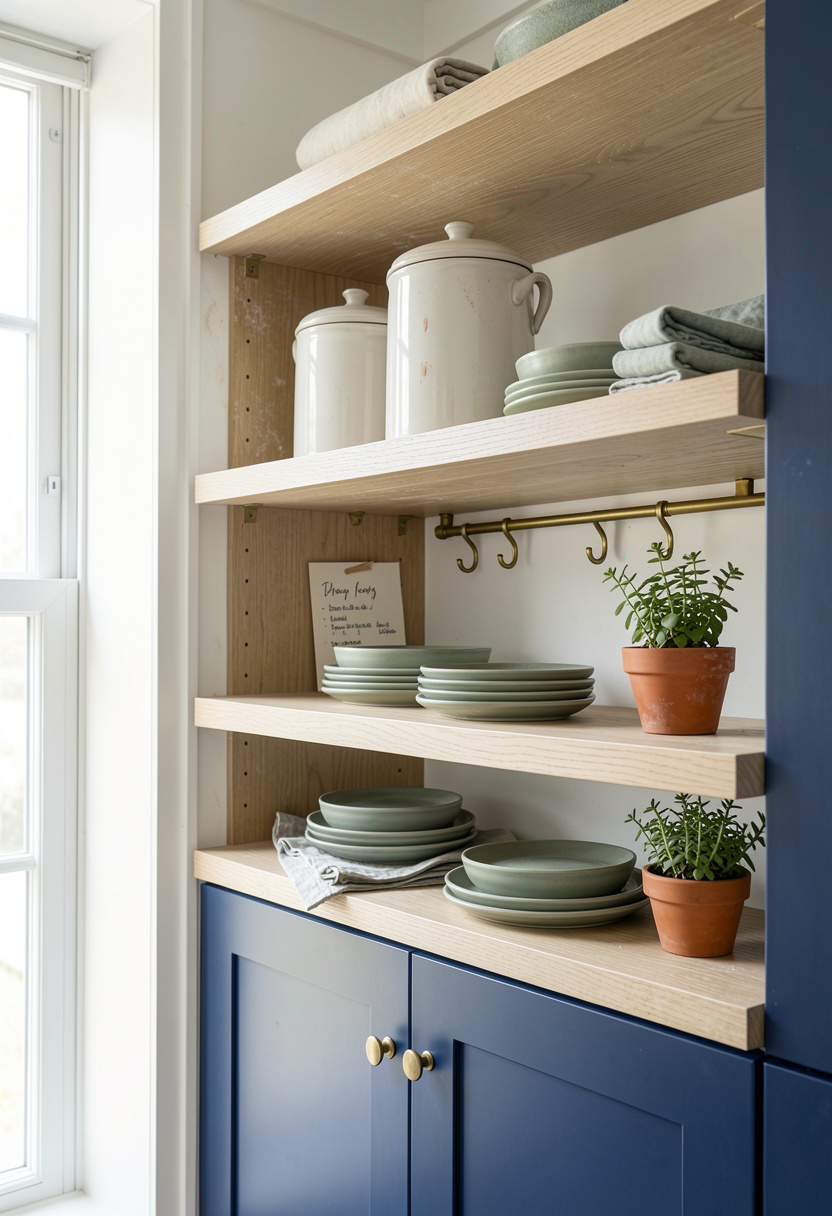
Open shelving makes blue cabinets feel intentional, not boxed in.
I installed two 24-inch acacia shelves and styled them with a Matte white ceramic canister set with acacia wood lids and a Set of sage stoneware plates.
Visual principle: vertical layering. Keep shelf spacing about 12 to 14 inches between shelves and 18 inches above the counter so items don’t feel cramped.
Style in groups of three to five. Stack plates, lean framed art, and place a tall vase opposite a low bowl for balance.
Mistake: filling shelves with identical items. That creates visual noise. Instead, mix heights, finishes, and a single unexpected piece like a small framed recipe.
4. Create Ambiance with Warm Diffused Lighting
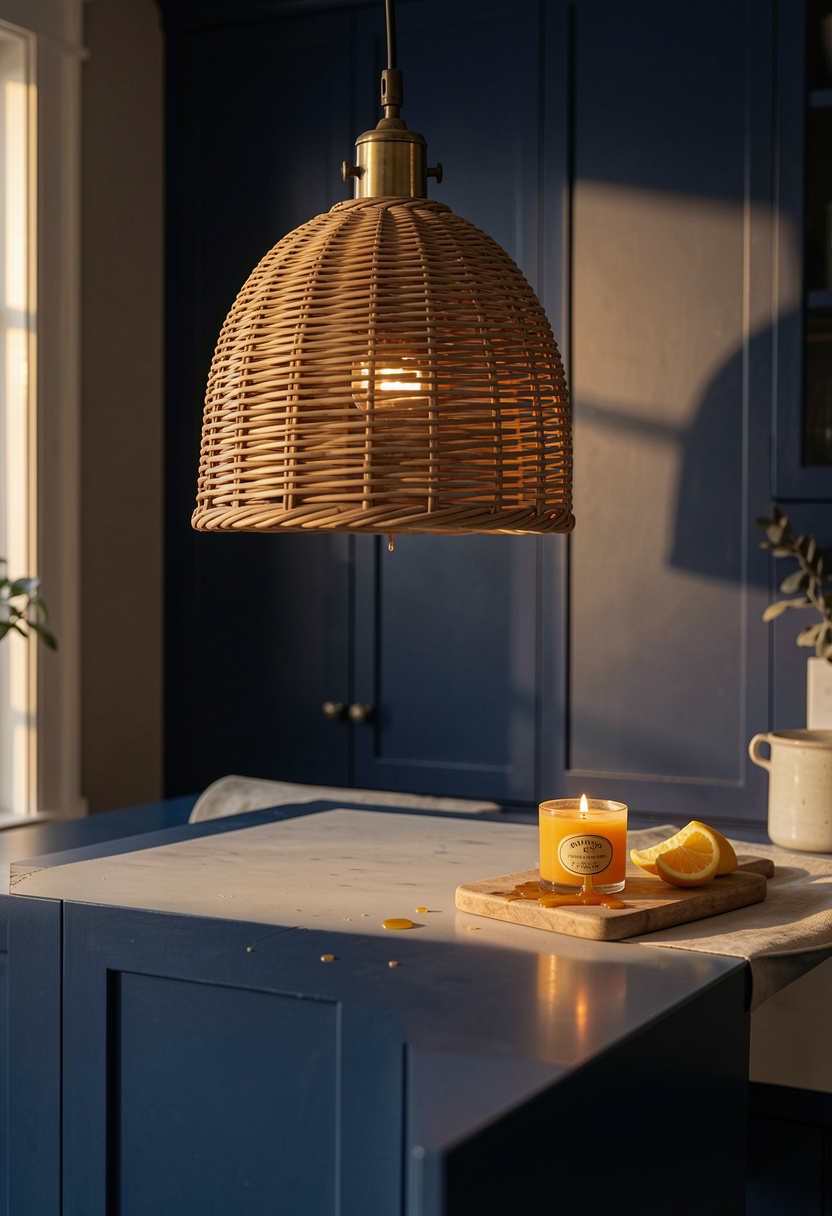
Lighting turns navy from brooding to inviting.
I swapped cold LED bars for warm 2700K under-cabinet strips and a rattan pendant above the island. Consider Rattan pendant light 15 inch and Warm under cabinet LED strip 2700K.
The visual rule is layering: ambient, task, and accent. Warm light softens blue, while directional task light keeps the workspace functional.
Place pendants 30 to 34 inches above the island surface for scale. Use diffusers or fabric shades to avoid harsh spots.
Mistake: installing only overhead cool lights. That makes blue read flat. Instead, add at least two warm layers and dimmers if possible.
Common Styling Mistakes to Avoid
Mistake: Choosing a high-contrast black counter with navy cabinets
Why it doesn't work: Creates a heavy, brooding feel that shrinks the room.
Do this instead: Pick a light grey or warm marble-look quartz. Light grey quartz sample around $10 to $25.
Mistake: Symmetrical canisters lined up across the counter
Why it doesn't work: Looks staged and static.
Do this instead: Vary heights and group in odd numbers. Matte white ceramic canister set does this automatically.
Mistake: Overcrowding open shelves with matching plates
Why it doesn't work: Loses the layered collected look.
Do this instead: Mix ceramics, wood, and a small plant. Terracotta herb pots set approx $12 to $25.
What You'll Need for This Look
Foundation Pieces
Honed marble countertop sample around $8 to $25
Extra large acacia cutting board 24 inch around $30 to $60
Matte black single-handle faucet approx $80 to $250
Textiles & Soft Goods
Sage linen dish towel set of 4 around $20 to $40
Woven jute runner 2×6 approx $35 to $80
Stonewashed linen tea towels $15 to $30
Lighting
Rattan pendant light 15 inch around $60 to $160
Warm under cabinet LED strip 2700K approx $15 to $45
Finishing Touches
Matte white ceramic canister set around $35 to $50
Terracotta herb pots set $12 to $25
Brass drawer pulls 3 inch approx $10 to $30 per set
Budget Swaps
Butcher block counter oil for reviving thrifted wood, $8 to $20
Vintage framed kitchen art search similar at thrift with Amazon backups $15 to $50
Shopping Guide for This Look
Buy countertop samples first: Order honed marble sample to see seams and light interaction before committing.
Thrift hack: Hunt for oak shelves or frames at flea markets and refinish with food-safe oil; keep acacia cutting board as a new fallback.
2025 trend tip: Look for sustainable finishes like FSC acacia. Acacia shelving 24 inch often returns to stock seasonally.
Splurge vs save: Splurge on a matte black faucet; save on softgoods like linen towels. Matte black faucet approx $80 to $250.
Conclusion
Start with one high-impact swap: the countertop sample or a large acacia cutting board.
The principle that won my kitchen was contrast without chaos. Keep textures layered, light warm, and accessories arranged in odd groups.
Which part of your kitchen will you change first?